Kenyan politicians have taken the Building Bridges Initiative (BBI) report and ran away with it, holding mammoth rallies and taking political positions. This was probably to be expected, seeing that BBI was put together to cement the relationship between political rivals, President Uhuru Kenyatta and former Prime Minister Raila Odinga.
However, the mission of BBI, too long and complicated to paste here, pledged, among other things, to create partnerships and collaborations between families, youth and community.
Many had hoped BBI would end the political rivalry between the Kenyatta and Odinga families, began by their fathers and carried over by the sons. The rivalry, spanning over 50 years, created deep ethnic schisms between their communities, the Kikuyu and Luo and by extension all Kenyan ethnic communities.
There were expectations of the BBI report becoming the bridge towards Kenyans negotiating coexistence, and politicians embracing issue-based politics as opposed to ethnic divisions by enhancing inclusion and equal access to opportunities and resources.
It may be impossible to get BBI back from the politicians and have the necessary conversation at community level on ending ethnic divisions. However, there are some spaces politicians haven’t infiltrated yet such as residents’ associations of people living on the same street or apartment block. Many residents’ associations are efficient processors of information and solutions.
Like most wedding committees, these associations are usually well organised and structured processes of interdependence and co-operation. Regular meetings are held, with rules of engagement, and respectful ways of calling each other to order. They promote a shared sense of common values, a sense of belonging. Ethnic or religious differences are often ignored in pursuit of common goals such as security.
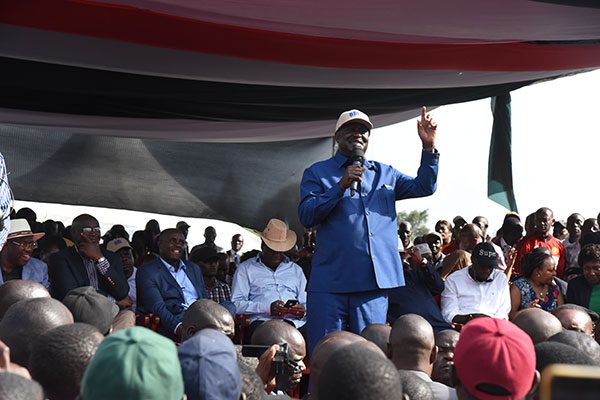
Kenya opposition leader Raila Odinga speaks at Bukhungu Stadium on January 18, 2020. Many had hoped BBI would end the political rivalry between the Kenyatta and Odinga families, began by their fathers and carried over by the sons. PHOTO | ISAAC WALE | NATION MEDIA GROUP
Young and old people are well represented in the associations. Members undertake voluntary tasks to realise objectives. Members demonstrate pluralism and provide legitimacy to all decisions taken on behalf of residents. Unlike in public life, politicians do not control the discussions.
Well intentioned neighbours can build inclusive societies that hold together particularly during elections when politicians begin the ethnic voting blocs power games.
One can only imagine the potential of resident associations with an enhanced mandate of promoting cultural diversity and increasing human interaction among them. It could begin with a simple invitation to bring a traditional meal from their ethnic community to share with neighbours at the next meeting.
Respectful dialogues by members consciously working on attitudes, behaviours and perceptions towards people different from them and enhancing social relations by valuing difference could follow.
Members can discuss dynamics inhibiting ethnic groups from connecting and analyse obstacles impacting improvement of social relations. They can draft basic guidelines for managing ethnic disputes, bridge intergenerational gaps and connect with national dispute relation mechanisms.
In communities affected by ethnic violence, members can support humanitarian efforts, give ideas on conflict resolution and ensure predictability in day-to-day transactions by ethnic communities continuing to trade in markets and shops.
Best practice would be developed on reinforcing ethnic social fabric and enlarged to bring in other people affiliated with members such as from professional organisations. Exchange visits with neighbouring residents’ associations would create opportunities to share experiences.
None of the above will be possible if association members are not ethnically inclusive. Exclusionary relationships quickly erode bonds of trust between people.
With time, strengthened association could hold politicians and public institutions to account on the detrimental effects of exclusion, discrimination, and inequalities.
Building inclusive societies has historically been a challenge worldwide. It could be made easier by not waiting on politicians for direction.
We can all contribute to the noble course of building inclusive societies. Each of us can begin with their residents’ association. Let’s do it.